
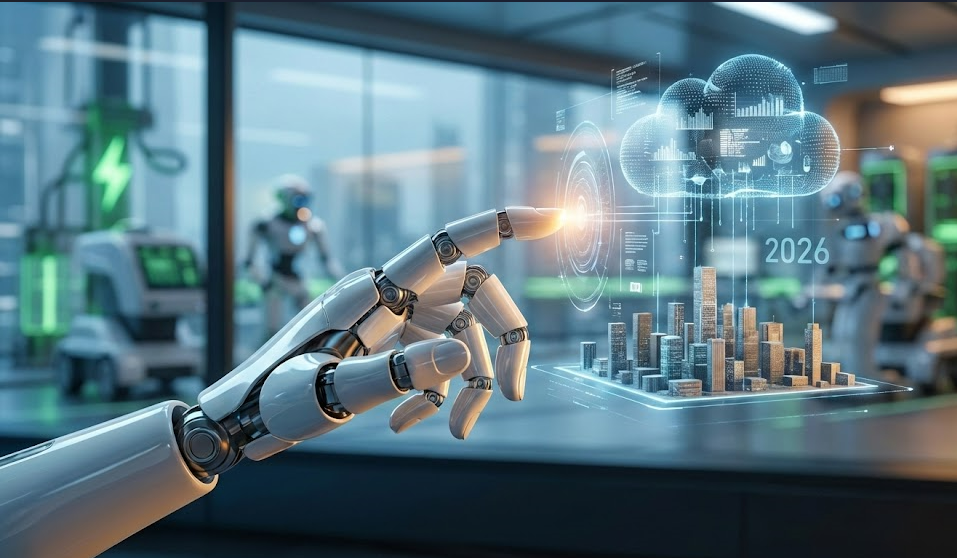
The Great Leap: Why 2026 Is the Year Technology Finally Got “Handsy”
There was a time, not so long ago, when our interaction with artificial intelligence was confined to a text box. We spent our days marveling at how a machine could mimic human prose or generate a surrealist image of a cat in a tuxedo. In early 2026, those days feel like the distant past. We have officially moved beyond the “talking phase” of the digital revolution and entered an era defined by Physical AI and Agentic Autonomy. This is the year technology stopped being a tool we use and started being a partner that acts.
The Rise of the Autonomous Agent
The most significant shift in the workplace hasn’t been a faster processor, but the evolution of the Agentic Workflow. In previous years, AI was reactive; it waited for a human to provide a prompt, and it delivered a single output. Today, we are seeing the widespread adoption of systems that can reason, plan, and execute multi-step projects without constant oversight. These agents don’t just write an email; they research the lead, cross-reference the data with a CRM, draft a personalized proposal, and schedule the follow-up. We are no longer managing software; we are orchestrating silicon colleagues.
This transition represents a fundamental change in how we define productivity. The focus has shifted from “How do I do this task with AI?” to “Which agents should I deploy to manage this department?”
Intelligence Steps Out of the Screen
While the software side of technology has become more autonomous, the hardware side has become more “aware.” Physical AI is the term on everyone’s lips this year, describing the moment large language models finally gained a physical body. We are seeing a massive convergence in robotics, where machines are no longer programmed with rigid, line-by-line instructions. Instead, they use self-learning algorithms to navigate the messy, unpredictable nature of the human world.
In the logistics sector, the impact is undeniable. Humanoid robots are now capable of navigating crowded warehouses and adapting to obstacles in real-time, learning from their surroundings rather than hitting a wall and waiting for a reboot. This isn’t just about automation; it’s about a machine’s ability to “understand” the physical context of its environment.
The New Architecture of Power
As these systems grow more complex, the way we power them is undergoing its own quiet revolution. For years, the tech world obsessed over the “Quantum Supremacy” milestone, but 2026 has embraced a more practical approach known as Quantum Pragmatism. Rather than waiting for a perfect quantum computer to replace classical systems, we are using hybrid architectures. These “Mosaic” systems farm out specific, high-complexity problems—like battery chemistry or molecular folding—to quantum accelerators while leaving the heavy lifting of daily data processing to traditional chips.
This move toward efficiency is also a response to the growing demand for sustainability. With AI’s energy consumption under the microscope, the industry has pivoted toward Edge AI. By moving the intelligence directly onto the device rather than sending every request to a massive data center, we are seeing faster response times and a significantly lower carbon footprint. It is a more decentralized, responsible way of thinking about the “cloud.”
A Future of Orchestration
As we look at the remainder of the year, the overarching theme is integration. The boundaries between “digital” and “physical” are becoming increasingly porous. We are living in a world where our software thinks for itself and our hardware learns by doing. For the professionals of 2026, the primary skill is no longer technical expertise in a single tool, but the ability to orchestrate these complex, autonomous systems toward a common goal. We have finally reached the point where the technology is smart enough to handle the “how,” leaving us to focus entirely on the “why.”